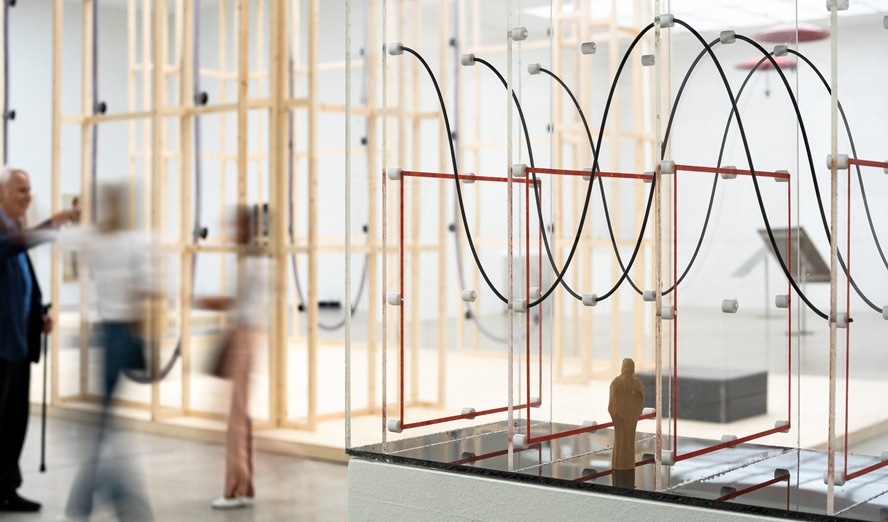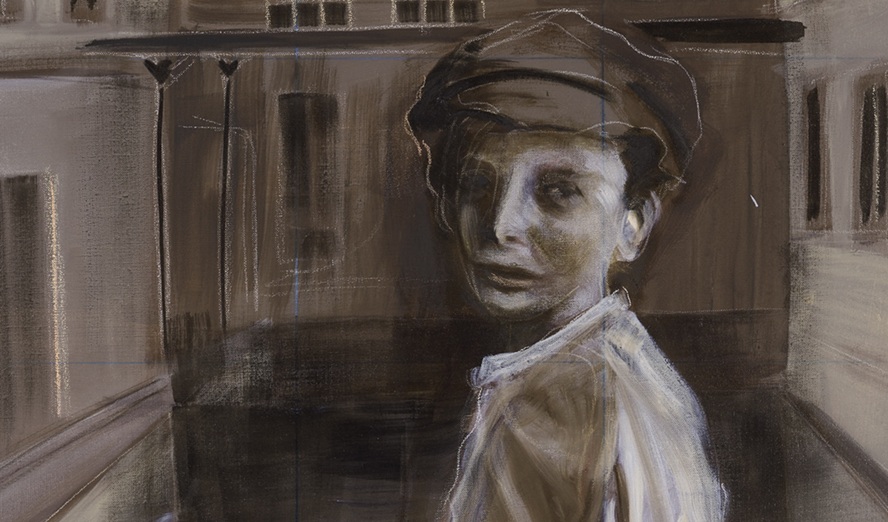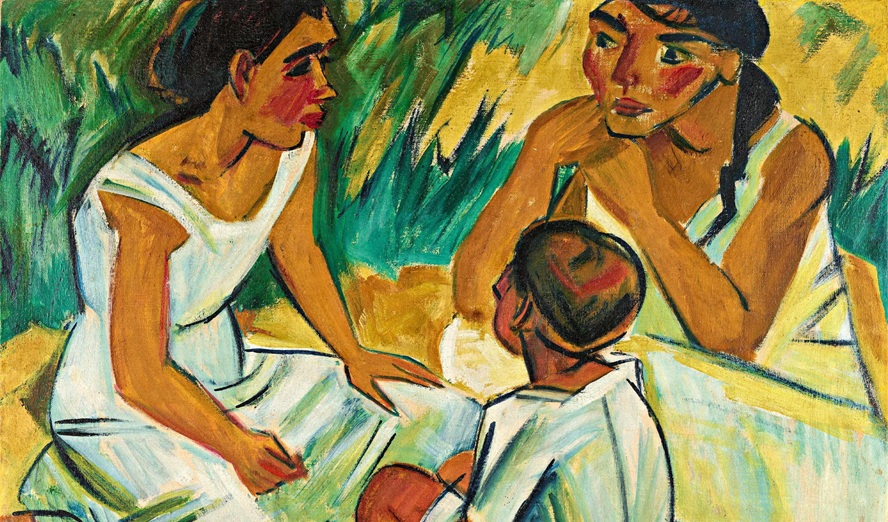
»Fragile Systeme« is a Soho in Ottakring exhibition, the result of research, reflection, and the visualization of vulnerable, precarious, and yet resilient relationships between people, nature, matter, and social space. It represents an attempt to create spaces in which fragility is expressed not as weakness, fear, and uncertainty, but as a starting point for new relationships and responsibilities. Drawing on the local context in Sandleiten and the spatial possibilities of Soho Studios, Soho in Ottakring offers a platform where artistic practices, collective (learning) processes, and discursive formats come together in various social contexts. »Fragile Systeme« also encompasses the fragile ecological relationships shaped by migration, colonial continuities, and social inequality. A key focus here is on collaboration with artists and collectives from regions where the effects of the ecological crisis are particularly dramatic – for example, in the form of water scarcity, the exploitation of natural resources, species loss, or social uprooting. The artist Daniela Brill Estrada presents a body of work that explores themes ranging from astrobiology and the origin of life to queer love and the fragile systems that are part of her everyday life and her inner world.
skug: What do you think, looking back at your life, where does your interest for the definitions of life from different disciplines come from?
Daniela Brill Estrada: Life is defined differently across the disciplines I have worked with: biochemistry, physics, astrobiology, philosophy, and poetry. But I think my interest in the origin of life started with a small obsession with death, weirdly. As a child, I used to think a lot about what would happen to my body after dying, how the planet would re-take my parts and make them part of the planet again, but in a curious way, just wanting to know. My aunt used to read me the poems of Alfonsina Storni, an Argentine poet, who I soon learned just walked into the ocean and died. I enjoyed thinking about her body becoming ocean, physically, molecularly, maybe because I liked the ocean a lot too. It sounds a bit dark, but for me, death was always a part of my life. Growing up in the 90s in Colombia, death was kind of normalized (and with it the most horrible kind of violence), in the news, on the streets, in territories around the country. I remember the murder of Jaime Garzón, a very influential person in Colombia who used humour to expose the darkest parts of the country’s politics and social inequality. The whole country mourned. I became interested in the transformation of the animal body’s matter as it changed state from living to non-living, in a forensic kind of way, questioning what would happen after the matter was part of the planet again: did it come back to life? In my mind, it was a single process that just happened to occur on Earth, where the planet’s materials would complexify, become alive, then die and start over again, not like a cycle, but in a weird flux of events I was curious about. Where did my flesh come from, what was it made of, and what would it become if I died? My father taught me physics, so I had to start with physics: how does planetary matter become life, and how does life become cells, neurons, muscles? How does it acquire consciousness? Maybe alien research could answer this? Or philosophy? I quickly got into biophysics, organic chemistry, exobiology, which, for me, seemed closer to poetry than anything else.
Could you describe the western society’s way to study life that you try to avoid?
A good friend of mine, Carolina Páez, a microbiologist and artist, told me once that while working in the lab, she had to focus completely on the data, the measurements, the machine, the methods, the code. Even while researching a living thing. She told me that, in scientific research, it was important to kind of turn off whatever the researcher’s body was saying. It did not really matter how it felt to do the research, but rather what the data showed, so that the research and its results were objective, clear, real, and neutral. I understand the necessity of science being objective, looking for patterns beyond the individual: the less emotional, the more real, closer to the truth. And I try to avoid the idea of not trusting or looking at or inviting the body into the research process. I think, for example, that this has allowed the social sciences to distance themselves from the humans they work with and the subjects they study, making science less empathetic. Or medical sciences to follow the evidence and data, not the feelings and the actual body of the human in front of them. Although I have seen for sure many, many researchers who fight against this actively, and make beautiful science in a very embodied, sensual, humane, and empathic way. Life is not really an experiment that can be replicated exactly, so it can’t really be objective; life is too complex, full of surprises, incoherences, and chaos.
You are a huge fan of the scientist Sara Imari Walker and in a lecture, you used a quote from her: »How can we uncover the physics that give rise to life and allow the transition from nonlife to life to even happen?« What is your present state of knowledge – concerning that question – in art and science?
I am a huge fan of Sara Walker because, when talking about the origin of life, she speaks about the information and materiality of life, and my artistic approach to the same topic is very much grounded in the same two things: materiality and information. This is what this quote is also about. On the Lex Fridman Podcast (#433), she explains that she understands life in material terms and says that our concept of matter has to expand to include the information it carries, which is also my approach to the origin of life from an artistic perspective. Walker says that life emerges when information structures matter within chemistry’s vast combinatorial space, building increasing complexity over time. In the past year and a half, I have been an artist-in-residence at the SETI (Search for Extraterrestrial Intelligence) Institute, and I have had the opportunity to meet other artists interested in how life forms on specific planets. In our collaborative project »Exoplanetary Poetry«, Julie-Michèle Morin, Bart Kuipers, and I have been working on the idea of communicating with possible aliens using chemistry, the trajectories of chemical elements, and the information they carry. And it all starts with how life forms from the specific matter and chemical elements found on specific exoplanets, the information that the materiality of a specific planet carries that could be able to complexify into life. Sara Walker could easily be an artist too, and that’s something I love about her ideas.
This is an artistic research question from you that I find very exquisite: »How to study life aesthetically?«
Carlos Maldonado, Colombian complexity researcher and friend, explained in one of his classes that the word »aesthetics« comes from the Greek »aisthesis«, which means the perception of the world through the senses. He said something that stayed with me and that I often tell my students: the opposite of »aisthesis« is »anesthesia«, not feeling anything. Studying life aesthetically does not only mean studying it through art or artistic practices, but also with the whole body and its senses, which, by the way, in humans, by some neuroscientific estimates, number between 22 and 33. I want to explore ways of studying life on this and other planets, activating as many senses as possible, and not anesthetizing them, which is what I refer to in my previous answer about the Western ways of studying nature; I would like to question this with my artistic practice.
Let’s have a look at your favourite anarchist saying: »Too much order is a sign of danger.« Please explain what you mean with this statement.
This is also a quote that Carlos Maldonado once said in one of his lectures about complexity and aesthetics. The saying basically calls out to beware of things that look too organized, of states and cities with perfectly cut trees and people with perfect uniforms and perfectly cut hair. A military state, the wish to end an entire culture to build something clean and white on top of it, it’s a sign of danger, the opposite of freedom. A shopping mall, one of the signature spaces of capitalism, where everything looks the same, nothing individual, one correct body, one correct mind, one correct way of living, everyone follows one dream, divergences avoided. Prisons, dictatorships, genetically modified crops so the fruits are perfect, organized, synthetic. Extreme order does not allow life, because life arises close to chaos; life needs degrees of freedom; life needs imbalances, surprises, sudden changes. It’s not about order. It’s about too much order, endless rules, productivity before happiness, anesthetizing technologies, apps, and smart objects that organize our lives too much, keeping us from empathizing with massacred communities or suffering animals. Reading another fantastic book, »Naming Nature« by Karol Yoon, I understood Maldonado further: using the science of taxonomies as the topic, Yoon explains how it used to be done using the body, sensing the surroundings, something she calls the »Umwelt«. Yoon explains how science started to be further away from the body, from the Umwelt. And now, we are so estranged from our bodies that we have forgotten how nature is ordered; we need a person in a lab coat to explain to us the most basic forms of mushrooms, berries, and trees so we feel safe eating them. Again, too much order is dangerous. The danger of not being able to empathize, because we are watching the floods, the droughts, the dryness of the land where data centres are built. We just don’t care anymore, because it is neatly packaged for us on our social media, easy to swap up, to not see it.
One of your favourite books is called »Why Fish don’t exist« by Lulu Miller. What do you especially like about this book?
This goes back to my previous answer, and to fish being one of my biggest obsessions, especially sharks, not considered fish, but being fish, which might seem confusing; that’s why I love this book. Lulu Miller tells the story of David Starr Jordan, a guy so obsessed with the correct ordering of nature, with the precise taxonomy of fish, that he became anesthetized to the rest of the world, going crazy, losing himself in the impossibility of reaching this perfect order. Lulu Miller wonderfully tells the story of the madness that comes from trying to reach the perfect order of nature; it’s a perfect example of how too much order can be dangerous. Miller explains how life always takes over, how chaos and unpredictable events such as earthquakes just overpower the wish for order. It was the cladists (people who ordered nature by clades) who, after Jordan, proposed that fish, as a taxonomic category, do not exist. I don’t agree; fish exist. Fish might be the most complex of all groups of living beings. Some of them, like the lungfish, one of my very favourite species, are genetically closer to cows and humans than to other fish like salmon.
Another interesting question deriving from your artistic research is: »How to dis-organize the studies of nature?« So, how can we do this?
By dis-organizing, I mean allowing a kind of childlike curiosity to lead the process of knowledge production. To disorganize the tidy laboratory and play around with things, objects, and words. Opening up different ways of studying nature to listen to and learn from each other, to enter each other’s spaces, changing methods, views, forms, concepts. One example is the DIGI-Sense project. I worked for two years with Claudia Schnugg, an art and science curator and scholar, at the JKU in Linz, at the Department of Communications Engineering. It was wonderful to be there at the moment when seemingly far-apart disciplines came together to conduct research through art. So far, we have published eight scientific papers together and had several artistic exhibitions, performances, and even a follow-up project. In this case, the Institute of Communication Engineering welcomed a team of artists to collaborate with its researchers to produce scientific knowledge and art together. They dis-organized the way they research by learning new methods, such as performance, and concepts, such as aesthetics, to produce more embodied, sensible knowledge.
Another very interesting theory from a complexity science researcher Carlos Eduardo Maldonado is that Western society was built by anesthetize knowledge. Could you explain what he means?
The quote of Maldonado goes something like »the history of the West is the history of the negation of the senses (…) the division of disciplines, the hierarchization of knowledge, the determinism, reductionism, dualism, mechanization«. He traced back the story of the West to ancient Greece, telling us how Plato kicked the poets out of the Republic because they were »too dangerous«; poetry was an imitation of an imitation, far from reason; and how later Aristotle cut the world into a bunch of static categories, disciplines, and ways of knowing: productive, theoretical, and practical kinds. Then Descartes introduced his mind-body dualism, dividing thoughts and emotions from the body, anesthetizing it. There are many other examples, including the story of taxonomies written by Yoon. The result, for Maldonado, is a society built on division (especially excluding aísthesis): it divides the world into separate parts, tries to control it, separates mind from body, ranks disciplines and, therefore, people, and places humans above nature. Powerful knowledge, but insensitive knowledge. Maldonado proposes getting closer to the body, knowing and thinking in synthesis rather than division, and understanding ourselves as part of life rather than above or different from it.
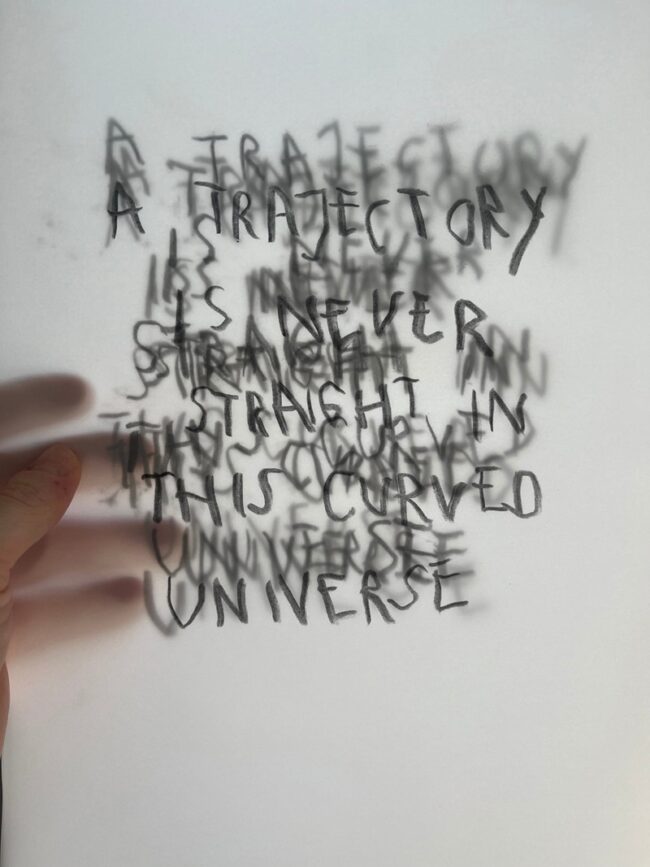
You described yourself – a living body – as a temporal trajectory of information. Please tell us how you came to that conclusion.
This is a fun one and is also heavily based on Sara Walker’s thoughts and on queer theory. To name myself a trajectory of information is to resist Western taxonomies and categories, the binaries of life/non-life, human/nature, male/female. It is to insist on existence as queer, anarchic, undisciplined, flowing, squishy, and free. For the past ten years, I have been studying trajectories, both as material and political things. A trajectory is visual proof of informational processes (like the tracing of a pencil on paper), which can also be the form and architecture of the materials that carry that information (like a human body). Matter originates somewhere and then builds every single body in the universe, and rather than simply moving in cycles, it constantly exchanges information; a piece of matter is never really a stable thing; not even in its most basic components does it hold still; it moves, interacts, transforms, becomes. That is why I call bodies (animal, mineral, planetary) trajectories of information: temporary stabilizations of matter shaped, among other things, by interactions, pressures, and environments. Same matter, different trajectory: me, a mushroom, the moon, my cat.
Could you describe your artwork that you present at »Fragile Systeme. Zerbrechlichkeit als Inspiration für das Zusammenleben in Natur und Gesellschaft« at the Soho Studios?
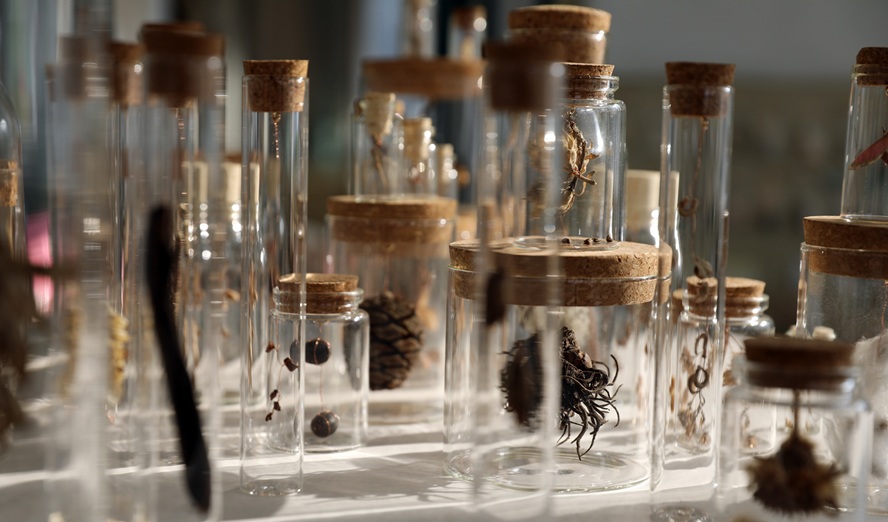
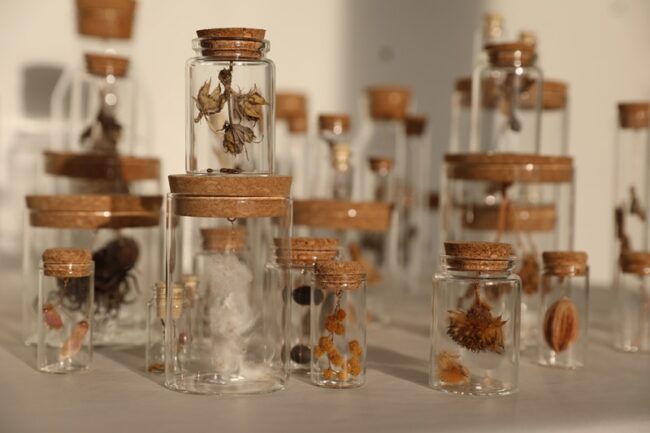
For the exhibition »Fragile Systeme«, I decided to focus on the different scales of fragility I discuss in my work. When I describe myself as a trajectory, or when I work on the origin of life, fragility is always a quality I mention. I start with carbon, because everything starts with carbon. It has been my main material for a long time, mostly as graphite or carbon-based ink. Life is not a fragile system, but it arises within a seemingly fragile environment. I feel like if even one little part of it was different, life would not have emerged and evolved the way it did, at least on Earth. »like a gastropod, dani« is an installation of over a hundred slugs made of graphite, an allotrope of carbon found in our living systems, but not quite alive. I made the slugs thinking about the Earth’s tectonic movements, moving steadily, surely, but slowly, almost invisibly. Slugs are also a biomarker of climate change and can completely disrupt a fragile system, such as a lettuce crop, due to shifts in planetary temperature. The drawings in »la línea más recta es curva« are part of my research on trajectories and speak to the instability and layered way I perceive the world as a queer person. The title of the series is a verse by Nicaraguan poet Ernesto Cardenal, who also deeply influences all of my work. The drawings of »coordenadas« are made with carbon-based ink, and I made one drawing of a landscape for every person killed in the Colombian massacres between January and November of 2022. Here, I’m showing a collection of 81 landscapes; the others are back in Bogotá, there are more than 220 in total. They show how fragile the landscape is to the killing of a single part of the system, especially with a violent death. Every other part of the system gets disrupted, mutilated, and seems empty and nostalgic, especially when viewed from the distance afforded by migration. Finally, the collection of seeds in »gathering dormancies« is my personal collection of seeds (I have to admit, some of them were lent to me), which has expanded over the past ten years thanks to my friends and loved ones. A seed is life in a dormant state, it defies time and is free in its dormancy; it represents how fractal, queer, soft, weightless, and fragile yet also strategic and strong vegetal life can be in its evolution and survival.
Link: https://sohostudios.at/events/fragile-systeme-jahresausstellung-von-soho-in-ottakring/