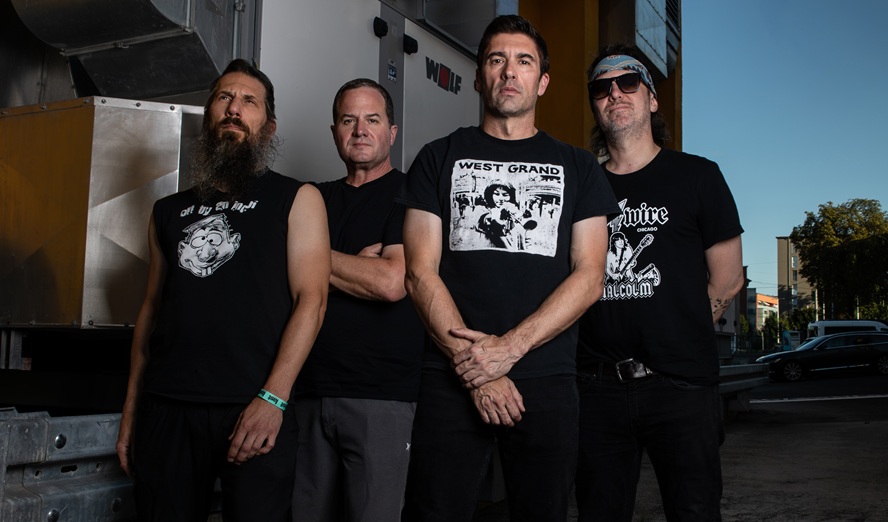
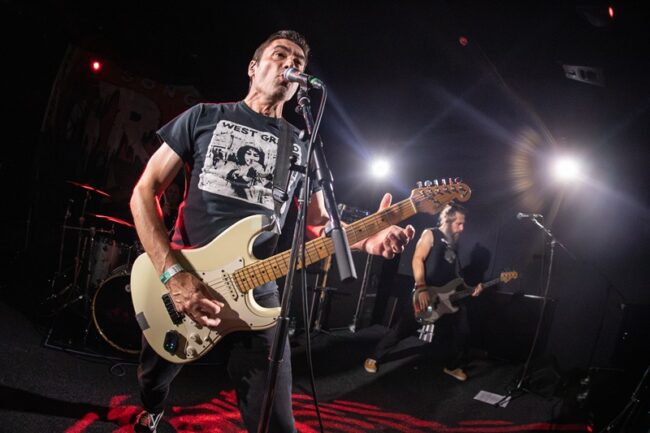
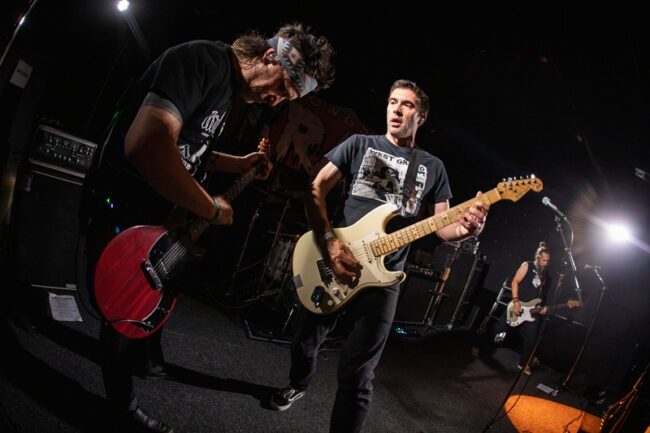
Horace Pinker’s return to European soil this summer proved that, even if being in a band isn’t your main job, you can still have the power to make people travel from all over the continent to see you rock their evening, no matter their age or marital status. The band constantly releases new music, and their latest fresh offering is still only a year old. Some of these songs were also in their luggage and unpacked on stage this August in Last, Linz, where also photographs contained in this article were taken. I talked with Bryan Jones (drums) and Scott Eastman (guitar, vocals) and the chat was as full-bodied and fun as one can expect.
skug: Your latest album, »Now and the Future«, was released 2025 on People of Punk Rock Records. How did the collaboration with this particular label come about, and how have people received the new album?
Bryan Jones: We’ve always released our music independently. Every record we have released has been done on our own, as we’ve set up the studio time, paid for the recording and then shopped it around to see if any labels wanted to release it. We’ve been very fortunate to always find a home for all our releases, but we’ve never been part of a label roster for more than one record. I don’t know if that’s been a good thing or a bad thing, but probably bad since we’ve never had that consistent push by a label to make us popular and sell records. That’s why Fat Mike said we’re the smallest band to ever be on Fat Wreck Chords.
Scott Eastman: We hooked up with People of Punk Rock Records last year, and they were quick to get our record out, plus they have lots of awesome bands on their label like Fenix TX and Restroyer. The guys are really active in the scene too. They also released our EP »House of Cards«, so we’re stoked about that. I think the record has been received really well – we’ve gotten some love online and some good reviews.
What is the younger generation’s response to Horace Pinker’s music?
BJ: My eleven-year-old son loves us!
SE: I think when we’ve played festivals like Punk Rock Holiday or even the Midwest Punkfest in Bloomington, Illinois, we get to play to different age groups – people who aren’t just older scenesters – and some of them know us from comps like »Cinema Beer Nuts« or from streaming our older records. It’s definitely fun to try and win them over!
BJ: Good to see some younger folks in the crowd getting into it, but I’d say the majority so far have some grey hair.
You look back on your time in Arizona as a period filled with clashes with local nazi skinheads who constantly tried to get into the punk rock shows you were also organizing yourselves. What is the situation like in your country in this regard right now, given the current political and social climate?
SE: Honestly, even though the far right is in power and there are even more organized fascist and violent groups out there than ever before (like the Proud Boys), they don’t seem visible or active in the punk scene, in my opinion. At this point, almost all the bands we play with are against the administration and are generally opposed to ICE, for example. So things have definitely changed in that sense – I never see anyone I can easily identify as a Nazi skinhead. And it’s a great change!
BJ: I think most people who follow our band and go to our shows share similar views, and therefore we don’t see a lot of that stuff. It’s the same thing with social media: for better or worse, we all kinda live in our own little bubbles. But, if a skinhead did come to our show, Scott would kick them out!
Your band started out in Tempe, Arizona, but shortly after forming, you moved to Chicago. Why this city in particular?
SE: After our original drummer Billy [ed. note: Ramsey] and I left college in California, because we were asked to leave by the school, we moved to Bill’s hometown of Phoenix and got started playing in the college town of Tempe, which is right next door. We spent our first few years playing relentlessly and went on tour before our first album came out with limited publicity or support (until signing to labels in 1994 and 1995). We called it »The Endless Tour«, and we essentially were on the road with bands like Jawbreaker and Agent Orange (and lots more) from 1992 through the end of 1996. By then, we had moved to Chicago and added a new bass player so Bryan could switch to drums. We added a second guitarist at about the same time, and a few years later Chris Bauermeister from Jawbreaker joined. He helped write and recorded the »Copper Regret« EP with us as well as featuring on a Canadian tour with the band All Systems Go.
BJ: Yeah, in the winter of 1993 we put all of our stuff in storage and went on tour. At the height of our popularity, we decided to take a break in 1997 (probably not the best musical career decision) and we all ended up living in Chicago by 1998 so we could work on our third record »Pop Culture Failure«. After that, we just claimed Chicago as our hometown even though all of us have lived in different places since then. Right now, though, we all live in Chicago, so it makes it a bit easier to be an active band.

Despite touring continuously since 1991, you have always held regular jobs alongside the band – jobs that, by your own account, you simply enjoy (or enjoyed). So, what do the individual members do for a living?
BJ: I started doing web development in the late 1990s as a side gig, and it just evolved into a career. Can’t complain, because it allows me the flexibility to still do the band. We’re all very lucky that we fell into careers that give us the flexibility to still do this dumb band.
SE: I teach European and Latin American history – I do enjoy it!
You also toured China. How did that opportunity come about, and what was it like to tour there compared to other – let’s say, standard – global destinations?
BJ: I booked that APAC tour entirely on an old social platform called MySpace. We hadn’t toured Australia/New Zealand since 1996, so it was really cool to get back down there again and also be able to stop in Asia for a few shows. The crazy thing is we did ten shows in less than two weeks on that tour. The final weekend we played Brisbane on Thursday, Wellington on Friday, Auckland on Saturday, and I was home in Chicago Sunday night having dinner with the family and then back at work on Monday. Crazy shit…
SE: We had the unique opportunity to play in Hong Kong and Singapore a few years back, and it was really incredible to meet people in the scene in Southeast Asia. It was different – especially in Singapore, where the club and the scene itself were definitely underground to avoid any unneeded encounters with the police or the authorities.
Over the course of your history, you’ve had the opportunity to perform at a number of major festivals around the world. How would you compare the overall atmosphere and approach at festivals in the US versus in Europe?
BJ: European festivals have always been an amazing experience and way ahead of those in the US, especially when it comes to the variety of bands. The festival scene in the US does seem to be growing, but I’d say the big difference is that it’s more club-focused instead of centered around big outdoor stages.
SE: The Fest in Florida is great, and the organizers have done an amazing job for the past two decades. Pouzza Fest in Montreal is similar, and it’s awesome. But they’re very different from European festivals because there’s no organized camping nearby. At the Fest and at Pouzza, there are multiple clubs that serve as venues, whereas in Europe, there are multiple stages but one space for everyone to interact. I would say that overall, it’s more communal in Europe, and it’s more fun in some ways. Other festivals in the US are fairly corporate, and of course, they’re really expensive. I don’t always love to go to those.
Recently, there have been reports of various music venues – including well-known ones – closing down across the US. How are bands, promoters, music industry professionals, and concertgoers themselves responding to this trend? Are new solutions being found in this area?
BJ: I think the cost of touring and the number of bands that are competing for limited space create a lot of pressure for the clubs and promoters to be able to book shows and not take a loss. I’m not sure what the solution is, but I do know that a lot of bands are more focused on doing only a few shows around a festival date than long tours.
SE: I think some of the festivals I just talked about are taking up the slack, and in some ways, club attendance in Europe and in the States might be falling because people are simply focused on taking a holiday and going to a festival to see as many bands as they can over a weekend. It’s great to see festivals popping up, and smaller bands that can play alongside the mainstays, but I hope people still patronize their local venues and dive bars, so the club scene doesn’t die!
Going on tour these days is becoming increasingly challenging from an economic standpoint, and for this reason, even major bands have recently been rescheduling or even completely cancelling their concert activities. What is your take on this?
BJ: Yeah, touring is expensive, especially when you’re paying a crew, booking agents, managers, etc. All the things that bands do when they are trying to make a living at it. Crazy thing is, if you talk to touring bands now, they will tell you that they are not in the music business anymore, but the merchandise business. It’s all about t-shirt sales now instead of records. That makes it pretty tough.
SE: Yes, you are entirely correct! Keep in mind we’re not trying to do this for a living!
Your line-up has seen quite a number of members over the years. What keeps you going all this time?
SE: Well, Gregg [Dessen] and Don [Meehleis] started in the band 26 years ago, so they’re the new guys. Otherwise, Bryan and I have been doing it since the 1990s. I hope I speak for everyone when I say we do it because we’re passionate about it. We’re not trying to make music for money. And when you’re motivated by the love of the music, it’s easy to keep going. We just toured Europe with Pulley (as you know), and I think they share a similar attitude, which is part of the reason we got along so well. And they’re just awesome people.
BJ: Agreed. I think when we took the business part out of being a band it really made things a lot easier and more fun. When you’re trying to make it as a band it really puts a lot of pressure on you and the financial aspect of it is an easy way to ruin relationships. The secret to longevity for a band is maintaining your friendships.