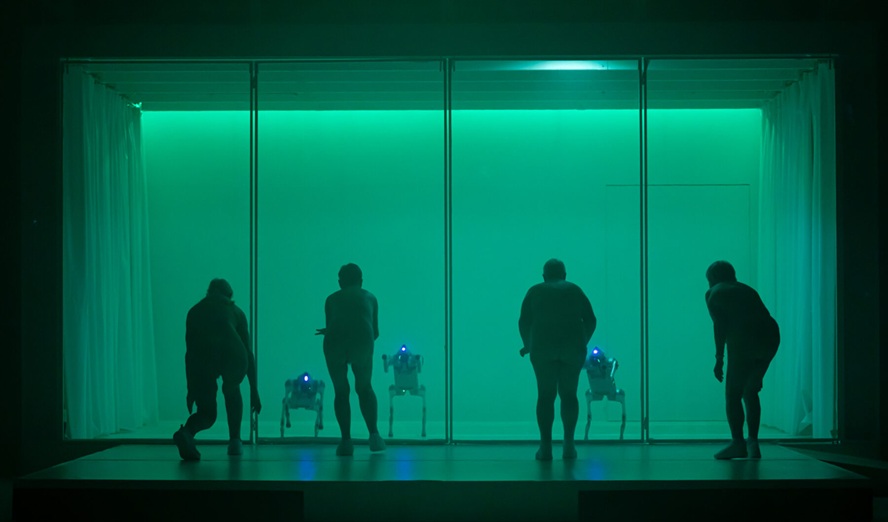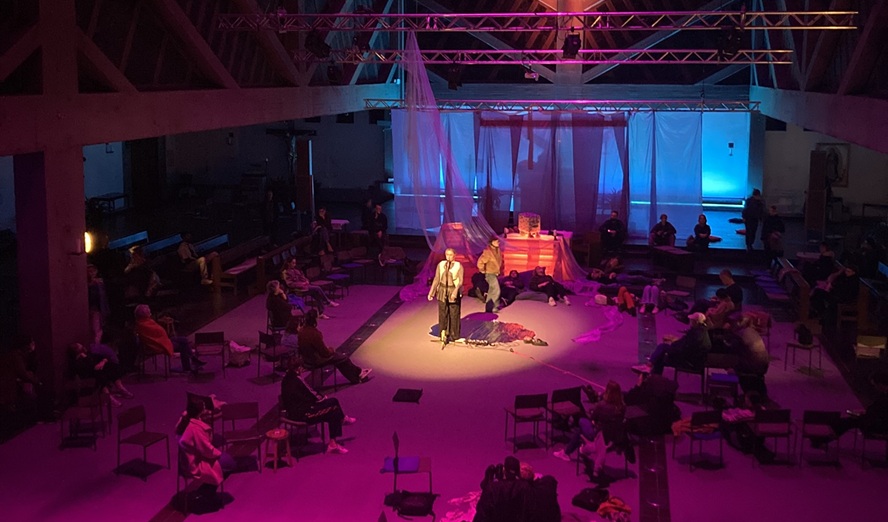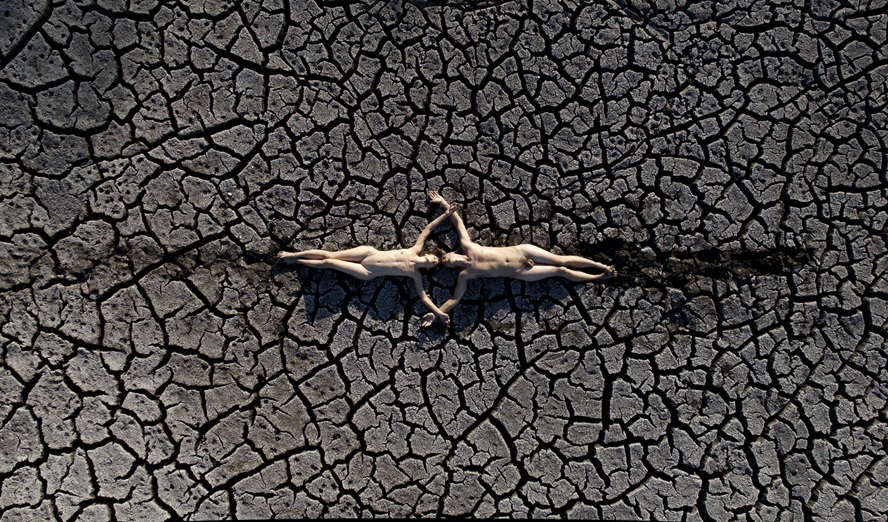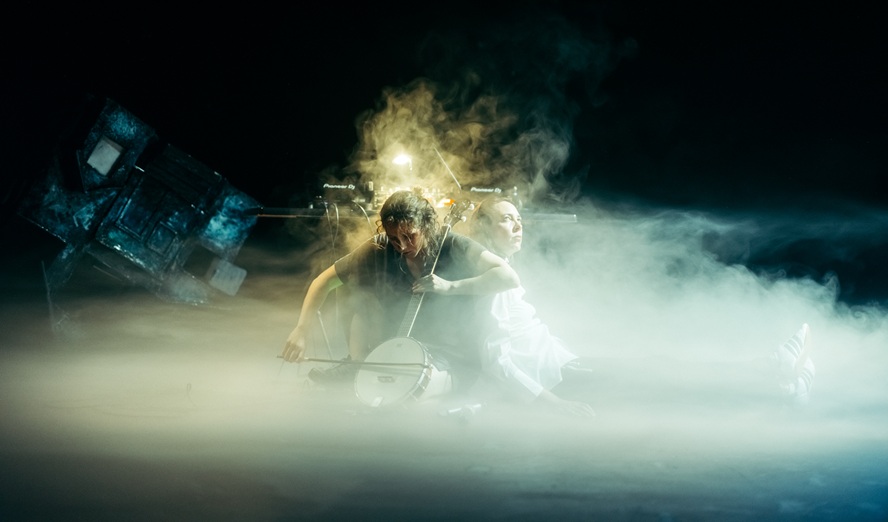
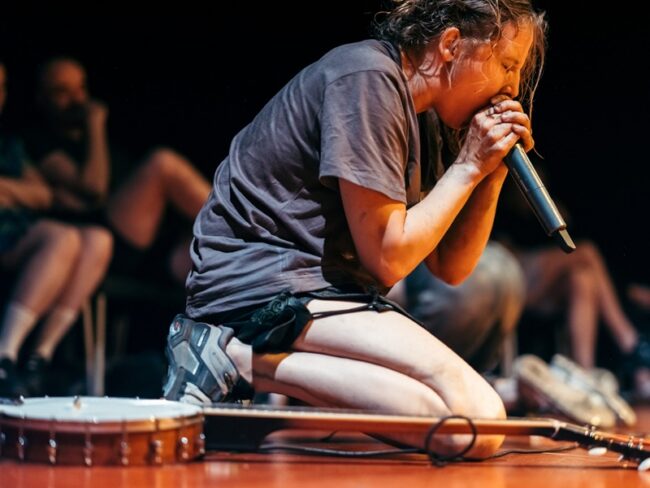
Performance artist and musician Netti Nüganen (AT/EE) steps into a dialogue with her surrounding stage environment by often working with large amounts of natural material such as clay powder, freshly mown grass, and ice. In addition to creating her own stage pieces, she has been touring with Florentina Holzinger’s performances since 2017. In »Ash, horizon, riding a house«, Nüganen and her two collaborators Pire Sova and Kisling reflect on identity and belonging as fluid constructs. By facing the instability of our environment, the audience is invited to consider how we might belong to a landscape that will not stay the same. Responding to a world where land, language, and folklore have become commodities, the performance unfolds as a series of chain reactions that Nüganen threads together as a narrator. She proposes multiple perspectives on locality by morphing through characters like a real estate agent, an auctioneer, and a tourist guide. »Ash, horizon, riding a house« explores how identity, as something shaped by geography, can open up space for fluidity, movement, and transformation. Melting becomes an act of resistance: against control and the desire to conquer. Viennese musician Kisling invokes a feeling for what might be lost. Seeded deep in our bodies, the vibrancy of spiritual song, the afterglow of campsite music, or the tunes of a millennial youth clash against a numerical grid of audio spectral analysis that distorts the memories of an all too idealised past. Kisling’s composition method, highly informed by digital processing and meant for contemporary DJ equipment, subtracts and morphs live-recorded samples into concrete snippets, enriching this musical experience with the immediacy and spontaneity of mixing techniques.

skug: Your performance »Ash, horizon, riding a house« is influenced by the topic or theme of »Dark Ecology« by the American philosopher Timothy Morton. What was so inspiring about this particular book?
Netti Nüganen: Dark Ecology is not really a doctrine; I would say it is more like a lifestyle, a mindset or a worldview. As I tend to be a little pessimistic about the future myself, I got a lot of support from this book – because Timothy Morton himself has probably struggled with similar feelings. But he found strategies on how to deal with them, ways of being able to think about the future, ways of co-existing and even getting excited about it, ways of transforming this pessimism. I actually started reading Morton through listening to black metal. There is a certain relation to nature in black metal, something that is not only about beauty or enjoyment, a harmonious refuge, but a world of conditions that challenges the ways in which we relate to our environment. It rejects the idea of »pure nature«, the green world is no longer the primary reference. So, it kind of reveals that something needs to be updated. It definitely also has so much romanticism and emotionality and even nostalgia in it. And from there I took it even further and started mixing the idea of country music into it. Dark ecological thinking trains the mind to see things in a very interconnected way. At one point, I wondered why I was suddenly interested in the banjo as an instrument. I listen to metal and noise music a lot, and I found an interesting hybrid in these seemingly very different genres: emotions like sentimentality and nostalgia are present in both country music and black metal. Identity and belonging are notions that are integral to these music genres because music comes with a certain way of thinking, a little bit like a school of thought. So, I started to combine it, and the world view of Dark Ecology became the umbrella. Regarding this, I found a nice conversation between Bjork and Timothy Morton online, I read it only recently after a performance show.
Please describe the sonic landscape of »Ash, horizon, riding a house«.
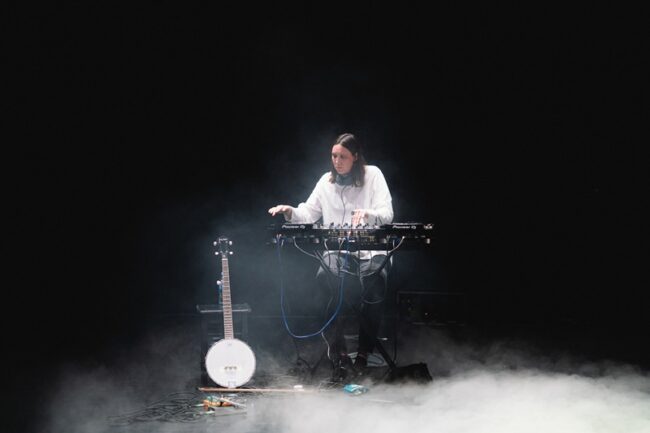
The sonic landscape between Michaela Kiesling and me is mostly improvised. I see it like a tourist traveling through different landscapes with a black sun, an image from black metal. Murmurs and sounds by Michaela guide that work throughout. I saw and heard a set from Michaela where she played with flute sounds. I liked her minimalist and even strict approach.
In an interview you mentioned that you like theatre plays by Samuel Beckett and Jon Fosse.
I like their minimalistic and experimental style, and I love their genre of plays. I like to read the dialogues, and I always appreciate it when people try to change the form of a genre, when they are experimenting with the format. That is also the reason I like the work of Michaela Kisling; as a musician with a background in visual art, she does interesting experiments with sound and music.
Your performances refuse a clear narrative; would you call your pieces post-narrative?
Maybe I am creating a narrative in the beginning and deconstructing it later. Suggesting a world that some people who attend my shows describe as nightmarish performances for kids. Happy elements combined with dark and weird stuff. I am using the bright sound of the banjo to contrast the unsettling things happening on stage to create a certain tension. This is the benefit of a performance – you can transform connotations.
What did you discover while learning and experimenting with the banjo as a performance instrument?
I don’t do much of the fingerpicking style. I try to cast out the demons of the banjo in my show. I already have so much sound material from banjo practice – not so much made it into this particular show, but I’m putting together a banjo live set. There are so many different ways I could go with it. So, let’s see. The sound of a banjo is very dominant and hard to fight against, so I try to distort it and bang it very physically. I think that is the reason I was interested in the sound initially. It has such a narrow reference in general, which is so unjustified, and it shouldn’t have these connotations all the time. We can find ways to look at it in a different way, to create different layers and dramaturgy around it. There are so many banjo players that don’t play bluegrass. So, I was fascinated by how stuck this instrument still seems to be in this distinctly American bluegrass ideology. What does that mean regarding storytelling? In Australia, I met Atavus Infectum, a banjo player who uses distortion and has a similar way of playing; we connected through this and talked about country music and black metal.
Why is a mobile house a prop on stage?
Thematically, it was very suitable as a vehicle. When I try to crawl into the house, it seems to be too small and not fitting. What is a perfect house? I love to play with very clear objects like a house or chunks of ice or an instrument like a banjo. When you think about those objects, you start to reflect on yourself, it reveals a lot, mirroring your status and your class. I think it is a struggle to find a sense of home in this hyper-globalised space we call Europe. What are our real living standards; how can we get used to lower standards? Everything can feel like home at the same time because cities look similar; so, as a traveling artist, you might wake up somewhere and think you are at home, only to realise you are just out there somewhere. This feeling of being lost, as a condition rather than a problem, is a Dark Ecology approach. You have to live with this feeling; you have to deal with it because it is too late to erase these circumstances. A Dark Ecology way of thinking is not so much the prevention of these feelings but dealing with the consequences. Being adaptable is an important skill. I play different characters in »Ash, horizon, riding a house«, contemporary archetypes like a real estate agent who sells this house at one point, then I am a tourist guide who demonstrates a mindset obsessed with ownership and commodification. What happens when we transform and melt these archetypes through ice? The ice in the show melts as these mindsets melt.
This interview was first published in a shorter version in German at mica – music austria.