Against the backdrop of this year’s focus themes of climate justice, democracy, and cooperation, the curatorial team of SOHO in Ottakring – Ula Schneider, Marie-Christine Hartig, and Hansel Sato – is exploring these issues in their major exhibition »What Grows Between Us«. Its starting point is the question of how new forms of coexistence, care, and resistance can be developed amidst the climate emergency. Feminist perspectives make it clear that the devaluation of nature and the discrimination against women and marginalised groups are closely linked and mutually reinforcing. Climate justice demands a profound cultural shift in which care, shared knowledge, and solidarity play a central role, rather than the search for technological solutions.
Monica C. LoCascio is a transdisciplinary artist who explores the materiality of invisible phenomena. Her works are artefacts of her material and theoretical research into memory, microbiology, theoretical physics, and structures of knowledge and power. She combines fermented biomaterials, recycled fibres, and traditional craft techniques with industrial and recycled materials to investigate the tension between the fluidity and vulnerability of lived human experience and the systems and institutions that impact it. She began her practice at the age of five, when she learned to crochet and embroider from her grandfather’s twin sister. She currently lives and works in Vienna, Austria.
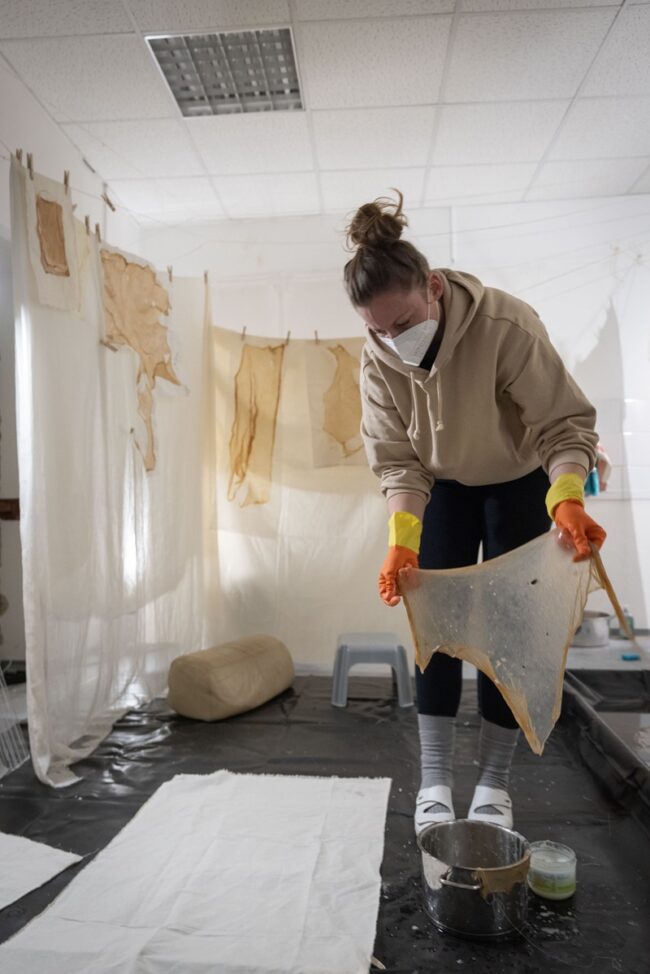
Monica C. LoCascio explores power and labour hierarchies through fermentation processes and her collaboration with microorganisms. Large-scale sculptures in the form of energetic portals investigate humankind’s capacity to shift perspective from its supposed material superiority over worlds of single-celled organisms, bacteria, plants, fungi, and animals. It is an attempt to bring viewers closer to an ecology of care, one that honours the work, practices, and very existence of our many symbiotic partners. Her research highlights the likelihood that all multicellular organisms on Earth evolved through symbiosis, in a dance of cooperative synergy, rather than through brutal competition for survival – so, how can we ever feel alone, when we humans are all holobionts?! skug needed to know more about her work and met her in her studio at WEST/WU.
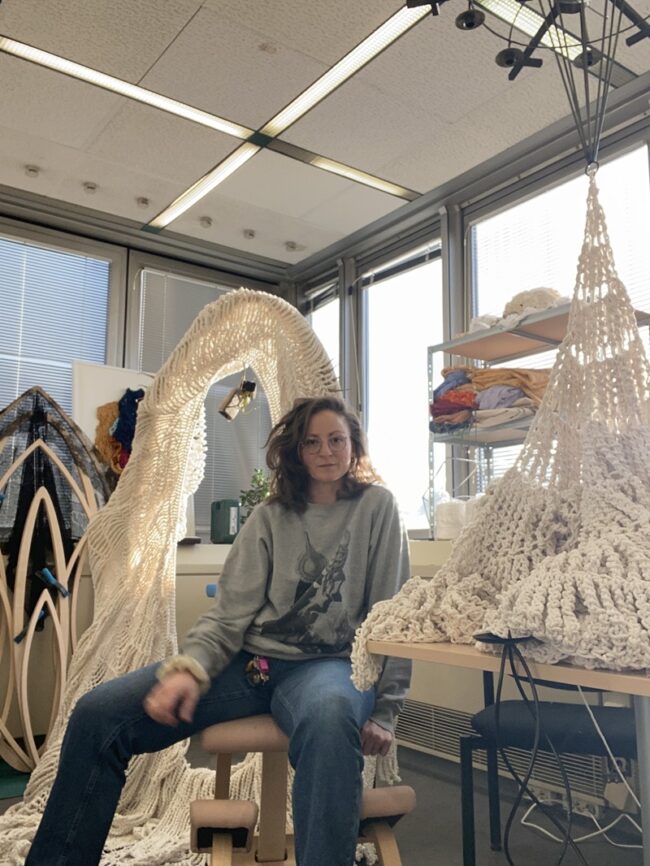
skug: How would you describe your work process? Is there a special approach that helps you create your pieces?
Monica C. LoCascio: My work can take hundreds of hours until it is finished sometimes, because it is all handmade crochet and embroidery. It is hyper-repetitive, and in 2020 I actually wrote my master’s thesis about repetitive creative work functioning as a somatic healing modality. After about an hour of work, I get into this flow state with my brain and my hands, and I get ideas or epiphanies about the work, also about my life, and I have visions of new pieces. I get moments of comprehension about what it is that I am making. It feels like excavating. I am not working to make and create something that looks a certain way, I start with a theme or topic (usually one that is invisible to the human eye or too complex to easily comprehend) that I am interested in, and I pair it with a material that is authentic to that. Then I pick a choreography of making or a geometry of stitching that illuminates, usually, quite a simple element of that topic. I use this process in order to understand the topic with my body or comprehend it on an embodied level. But because I am always researching invisible phenomena, whether it is epigenetic memory in our DNA or things that you can study through a microscope on an atomic level, my works become about making things measurable and sensible and felt by a human body, particularly my body. So I try to visualise my concepts and topics in a simple way. I end up experiencing and learning a lot about the topic I’m researching through work.
Do you always document the ideas that come to your mind while creating, or as you call it »excavating« your pieces of art?
I am trying to collect those thoughts now in some kind of comprehensive text. I like that my work can be quite abstract but that in an exhibition context people get what it’s about and it seems to resonate with them on a deeper level. When they notice something and get emotional about it and talk to me about it, it is wonderful and shocking to me. With my art, I am trying to understand profound things, and I try to translate it by walking this line between the more metaphysical and the scientific concepts. I think many things that we call metaphysical right now are phenomena that we have not built tools to measure yet. However, we can experience them because we live in bodies with senses and capacities and DNA that have evolved since the beginning of life itself. We evolved to sense and know things that we cannot yet measure. Coming back to your initial question, I am also trying to document these ideas with my titling and through citing resources.
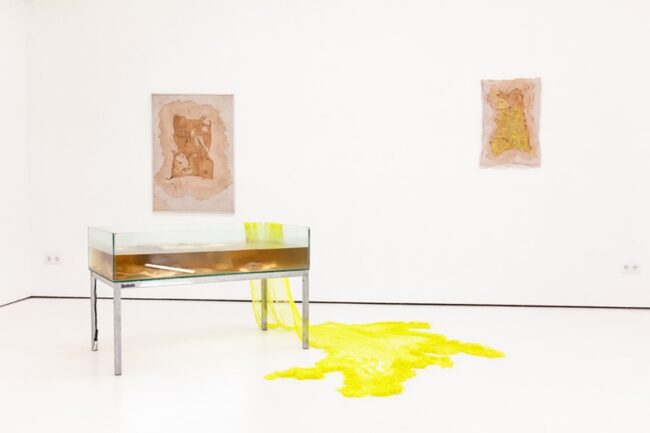
I read that you try to »extrapolate a mistake« in your work. Can you explain what you mean by that? Is it an artistic way of »failing forward«?
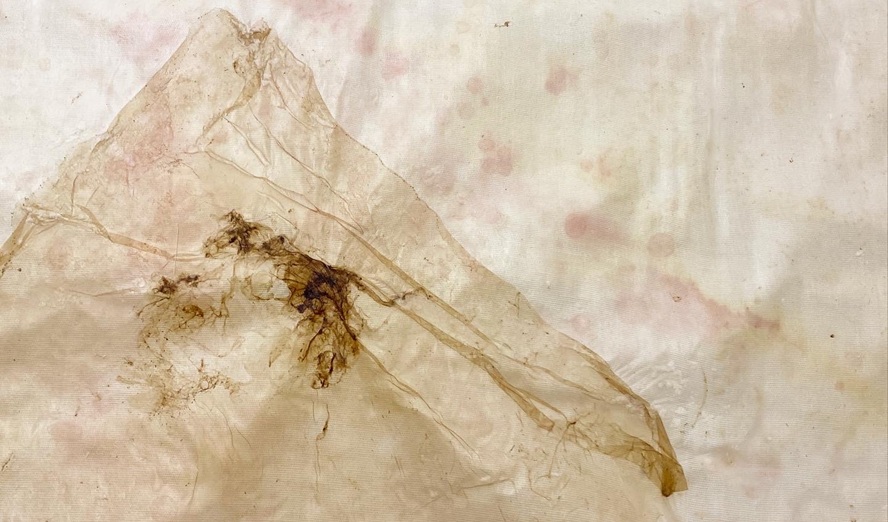
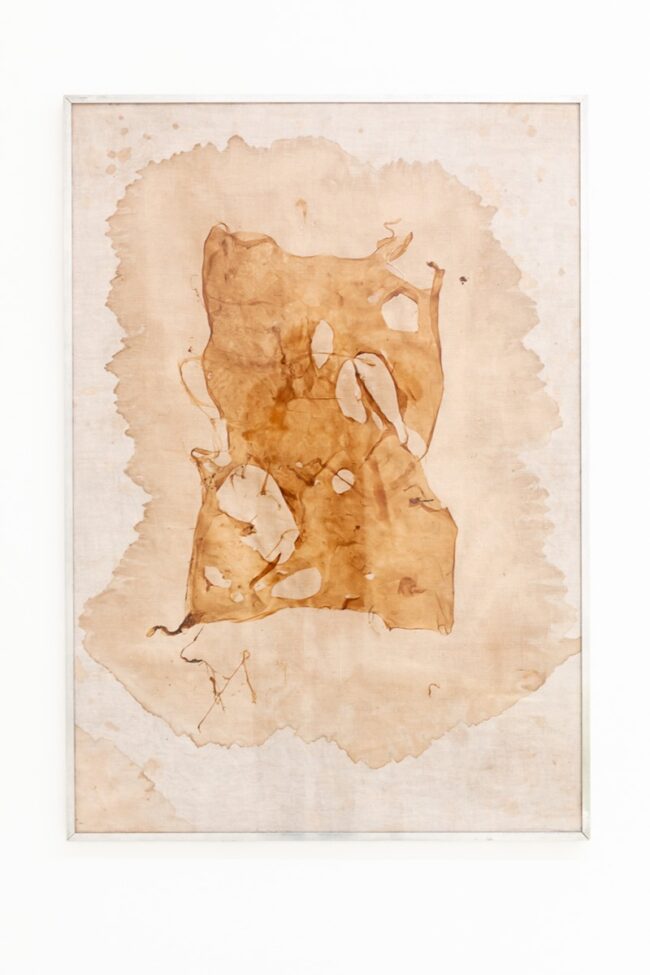
In my iterative works, I am doing things over and over again. And if I make a mistake, I leave it, because if you do something five times, you can see it. If you do something five hundred times, you can start to understand the intricacies, but if you do something five thousand times, you really start to understand a different dimension of the thing that is leaving or being channelled through your body. We learn through mistakes, and now, as a mother especially, I am understanding that through teaching my child that mistakes are great on a purely elemental level. I am not just conceptualising failure, but I do think that it is powerful to embrace it. Some of my favourite works are pieces that resulted from fuck-ups, like the first scoby that I harvested for my master’s thesis in 2020. When you take a scoby out of the tea, you have to wash it to kill the bacteria to stop it growing. I was wrestling with this giant scoby squid in the shower, trying to wash it but completely incapable of doing a thorough job because it was so heavy and slimy and unyielding. I was also terrified to damage it. Because of that, it was not fully washed and so some spots were still alive and growing as it dried. Therefore, I was exposed to so much about the quality of the material and the aliveness, and it reminded me of the age spots on the skin of my grandmother’s hands. The piece was then titled »My Grandmother’s Hands« because that work using different generations of scoby was also about generational trauma. I talk about that topic, how trauma is stored in our bodies, also in my master’s thesis. I started working with scoby as a pretty simple metaphor for skin and bodies, but in the learning process of the last six years, it has become so much more through experiences like the one with that first big scoby. There is always a feedback loop of meanings and discovery of forms and outcomes in my process.
You mentioned the topic of epigenetic trauma that seems to be linked inherently with the qualities of the materials that you use. Could you talk about that?
The definition of trauma that stuck with me: It is an experience that pushes the nervous system with something that is too much, too fast, and too hard to process. Animals are very good at handling that breaking point of a trauma. A small animal that gets chased by a bigger predator and escapes often has a physical response afterwards. They release the trauma from their body by shaking. That is their inherent ability to understand that the event was traumatic, and their body knows to automatically process and release it. The nervous system is a mechanism. Trauma is not only a human idea that we are upset about something and cannot let it go. It is literally an imprint on your nervous system, it is stored in our body. So trauma was the gateway for me to learn about epigenetic memory, which is a very intriguing concept to me in terms of trying to understand my experience of the world. I struggled with PTSD pretty much my whole life, and crocheting and embroidery was a way to find a rest for my neurodiverse brain. I wanted to know more about how trauma can be solved and cured. I read a text by Amy Stacey Curtis about traumatised artists who work with hyper-repetitive mark making or processes. That was a life changing moment for me, a full circle moment of understanding my body experiences and reality. I read studies about epigenetic memory and the nonlinear time of quantum physics. What are the imprints and programs in my body that lead to my experiences with my environment? How many lived experiences do we have programmed into ours? How many ancestors’ experiences do we have entangled with our own? Mitochondrial genetic DNA shows us that every human alive on Earth likely comes from one of seven women. And the symbiogenesis theory of evolution explains (this is very simplistic) how one bacterium collaborated with another bacterium and that is how multicellular organisms evolved. Can we please think about that a little more when we think about »me« and »mine« and boundaries and borders? Genetically, we have way more bacterial DNA than human DNA.
Another aspect of your work is that you are working with used material. Is the memory of textiles important for you, to visualise what you call »unseen forces«?
People sometimes bring me metal or wooden trash that they find in the street. For example, look at that iron door handle. Industrial material like that symbolizes capitalism, patriarchy, linear-time thinking, manmade systems that soft, squishy, vulnerable bodies always operate within and against. I question their downfall, their rusting and falling apart and dissolving. Essentially, I would also call DNA a quantum textile. I am super interested in how material holds memory. Found materials as vibrant matter have a certain energy and a consciousness. Meanwhile Dr. Tony Nader describes how everything / anything that has a response to gravity has a consciousness. I obviously only have a personal working theory about consciousness, but I believe that it is very egotistical to think that humans are the only living beings that can be traumatized or live complex emotional lives. I have an utmost respect for scientists, and I believe that the mainstream »reality« of science is only our current best model for understanding the world.
Why do you combine artistic and scientific methods to develop your works?
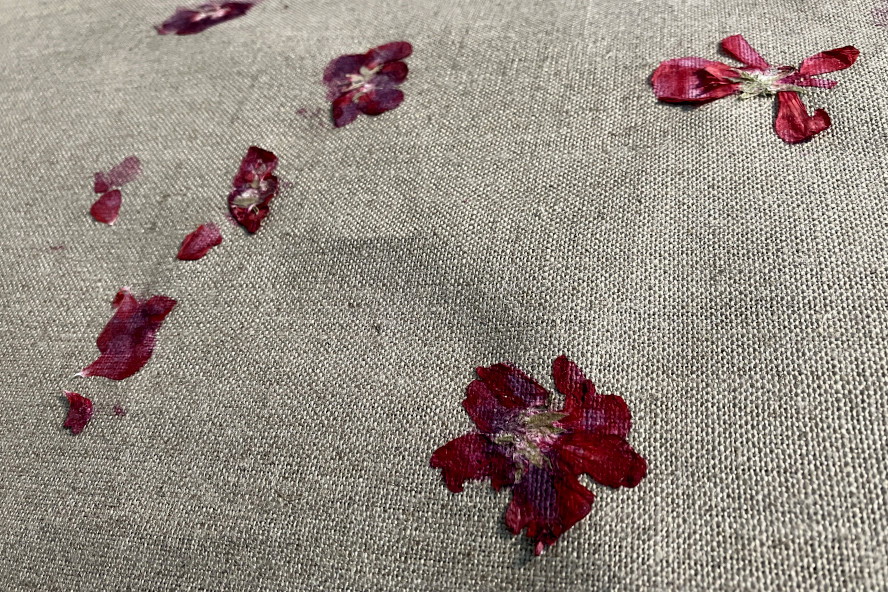
Art is important because it allows people to question and feel things on a visceral level and connect emotionally with concepts. It is our feeling brain that can make lasting change in our lived experience, way more so than our logical brain. Art for me is a way to understand complex systems like our bodies or the universe. I’m not patient and linear enough to be a scientist and could not work within the time frames and strict hierarchies of ways of knowing and experiencing inside a research lab. My brother is a neuroscientist, and my father was a biologist. I have a lot of admiration for their capacity to work in that way. But my way of understanding is more cyclical and spiralic. I have to use my hands, and I clearly work in a nonsterile work environment. There is something about harnessing chaos that is enticing for me. I am not married to a special material or way of working, and I like to follow my curiosity. It’s always profoundly valuable for me to follow little intuitive hunches and use my body compass during the development of artworks and research topics. Crochet is a very simple technique: a loop through a loop; one loop after another. It is super strong, but I can unravel the entire crochet if I want very quickly. And only human fingers can do it, machines and computers cannot crochet. So, what is high-tech and what is not? What is sensitive, what is not? When I for example work with handspan linen, antique material that is preowned or pre-used, it is almost as if I am reading that fibre like a record needle. Vinyl records have way more information and data contained in a physical device than in an mp3 file. It comes down to questions of value. I might be a bit of a Luddite. Luddites were a resistance movement that originally started in Nottingham in response to textile production going from hand to machine operated. These people were against industrial weaving because it would take their jobs. Nowadays you call someone a Luddite if they are anti-technology. And I am generally a little bit sceptical of a technology like AI. It is a disaster because our body is this incredible sensory and productive technology, I can affect reality with my thoughts! I rally against technologies that take away our human powers, we are losing muscle and brain capacity. We are de-evolving by exporting body capacities to technologies. High-tech does have a connotation of a higher value, and that has a direct effect on our existence and ecologies. Our global economy is based on a more-or newer-is-better model, and our capitalist society is a direct product of a minority having the power to exploit the rest. But without the unpaid care and labour mostly done by women, capitalism would come to a halt and could not exist. And we should not forget that without bacteria, life on Earth would cease to exist in about half an hour. So, when we talk about what is valuable and don’t recognize microorganisms or those engaging in reproductive labour, we are denying their roles as life-givers.