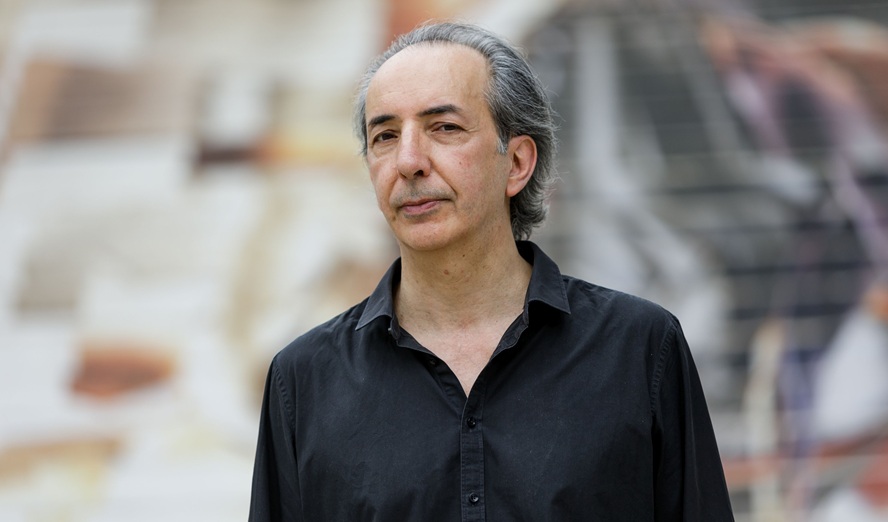
The relatively new science dealing with interoception contradicts an image, which has dominated Western thought since René Descartes’s seminal dictum: »I think, therefore I am.« The sense of what’s happening in one’s own body can be trained, not only through mindfulness and relaxation. Can actively listening to compositions of contemporary music contribute to improving self-esteem and body awareness? Listening to the unique and intense compositions from Pierluigi Billone one might experience a new sense of self-efficiacy. skug wanted to know more from a composer that demands attention, a creator of soundness between seemingly chaotic instrumental and vocal sound eruptions and ever-returning, tense silence.
skug: Dear Pierluigi Billone, you once described studying the films of Andrei Tarkovsky as a major influence on your work. How did that come about? Do you also relate this to the book »Sculpting in Time«, in which he writes about art and life, about directing, the role of the actor and the audience, about camerawork, music, editing, and screenplay?
Pierluigi Billone: Andrei Tarkovsky’s work has been and still is, for all of us, an inexhaustible source of inspiration, reflection, spiritual strength and concern for humanity, and, without a doubt, an example of dedication and consistency in life and work. I still remember a television interview he gave in Italy in 1983 (he was an exile in Italy at the time), where he introduced the film »Nostalghia«. As he himself would have said, it’s impossible to separate these aspects of the man from the concrete reality of his work. I literally studied his films, deconstructing them (in the late 1980s, it wasn’t easy to get a video of the films), patiently transcribing them into a sort of technical »score« that I still preserve, trying to understand what made the reality of those works possible. It was an extremely slow, long process, which today, thanks, for example, to the posthumous publication of documentaries about his work shot on film sets, I understand even better. From these studies, I learned to focus on the objects of my attention, to imagine their possible evolution, according to principles I felt necessary but which I couldn’t find in any musical example I knew at the time. Obviously, this long, in-depth study – only seemingly technical – led me to an even closer connection with his entire oeuvre. I focused in particular on the films »Stalker« (1979) and »Nostalghia« (1983).
In your opinion, the dimension of solo music – precisely because of the »real conditions« in which it takes place – is the one that offers the greatest opportunity to unite performer and listener and to almost eliminate the differences between the roles. Is this still of fundamental importance to you?
Certainly, and with ever greater conviction. The intimate and collected dimension of solo music (or music for a few performers) is certainly a condition that enables the experience of sound as »communion«, which remains the foundation of sound practice. The real experience of sound that can be had in the direct, intimate, almost unifying contact of solo music seems to me all the more necessary and indispensable today, because the relationship with sound has completely degraded. This concerns the listener above all. For the composer, it is an opportunity to experience a particular individual freedom: the ability to go far. In ideal conditions, free from any external professional obligations, I can and must decide what to do only based on the limits I myself feel are necessary. And above all, I have the freedom to go beyond the limits I have set for myself.
A dissipative nonequilibrium system is an open system that is in disequilibrium and exchanges energy and matter with its environment. These systems depend on a constant flow of energy to organize themselves and form stable structures, whereby energy is irreversibly converted, i.e., dissipated. Examples include living organisms, weather phenomena, or economies, but also, I think, your compositions. Can you relate to this comparison?
I honestly don’t know how to answer. I prefer to identify with these words Pier Paolo Pasolini has Medea say (in the film of the same name): »I have remained what I was, a vase filled with knowledge that wasn’t mine.«
You once wrote: »A question can have very different forms. A true question generates an obstacle that requires understanding and constant attention. It limits a space and a field, marks a boundary, or defines a significant void. Certainly, it commits to the exercise or abandonment of a point of view. A true question invites to a vision. A question always risks going unanswered or requiring a lifetime commitment.« As a composer, what are the questions that attract your attention at the moment?
I became a composer (of written music, for performers who perform it in public) because I felt with extreme clarity that placing sound at the center one’s work and existence could be a special opportunity for knowledge, one that only sound could make possible. I believed in this and continue to believe in it. Over the course of all these years, I have realized with equal clarity that for most people, unfortunately even for many musicians, sound is anything but an opportunity for knowledge. The very term »knowledge«, when applied to sound, seems empty and meaningless, or is interpreted as typical pseudo-intellectual blah-blah, equally empty. I have definitively understood that the experience of sound that we moderns have, given the conditions of our current Western material culture, is absolutely superficial and irrelevant. If this is so, the very possibility of knowledge, whatever it may be, is excluded in principle. But the emptiness, the disorientation, and the real restlessness that I recognize beneath this »deafness to sound« speak to me and question me. I take all this very seriously, like a sign to decipher that slowly seeks to become a question. It’s still difficult for me to formulate the question, even though I feel it close, open, and urgent. Let’s try. The fact that we can no longer perceive the relationship and experience with sound as an opportunity for knowledge doesn’t mean that the profound need for that knowledge has disappeared. It means that we are no longer in relationship with it, that we no longer know what it is. This is a spiritual and existential loss. All the more significant because we don’t even perceive it as a loss. Are we ready to give up everything we’ve always considered sound (which is now an exploded, degraded and empty entity, or a digital object), to give a chance to exist to a knowledge we’re losing? Are we ready to venture into an activity that initially might no longer even have a real, defined object? And to what extent? These words are deliberately obscure, uncertain, and ambiguous, and must remain so. Perhaps they can only speak to those who are truly searching for something (certainly not to idiots…).
You once stated that »sound can be thought of as energy and matter«. You named two scientists that discovered fundamental space concepts (on a micro and macro level): Niels Bohr and Edwin Hubble. Listening to your compositions, it seems that they deal with expansions of time and expansions of common structures. Concerning your recent compositions – how did you approach topics as space, void, duration in your compositions? In an empirical, experimental way?
It’s certainly possible to take one aspect of the life of sound as the object and purpose of a work and develop it. To do so, however, the other aspects must recede to the periphery, remain secondary. This isn’t my case. I’m interested in a full life of sound where all its dimensions are always active and interacting. Therefore, my work doesn’t necessarily deconstruct the life of sound into parameters to be able to work on them separately or reconstruct them a posteriori. This isn’t how I concentrate in my work my knowledge of the life of sound in space – real or visionary – or the rhythmic sense of the duration of sounds. The same goes for »void« (a rather difficult notion to define in music). I think and work like this: that particular sound of the bass clarinet, pppp, isolated at the edge of the space of the sound sources. The sources are inactive and motionless on the stage, and thus reveal the absence of any voluntary activity. If the duration of this sound exceeds the rhythm of breathing, the typical rhythm of what has happened up to that point, the rhythm of every possible interaction of the other sources, this sound becomes the momentary center – in every sense – of what happens: it is space, void (emptiness), and duration, inseparably. The next instant will alter this momentary balance of factors.
»A musical work already contains within itself the kind of possible listening. A musical work creates its possible listener. It already encapsulates the answer to the question what music is, what sound is, what listening is«, you framed some thoughts about experiencing your music. So, what does »awareness« mean in the musical field of contemporary?
A composer’s work doesn’t emerge from a vacuum; it is deeply rooted in history, in the social and professional context in which we work, in material culture, and so on. All these factors interact and influence, to varying degrees, what we do and think. When our work begins to exist publicly, it has the potential to become an active factor in itself, interacting and influencing. It’s possible to simply and obediently let ourselves be drawn into this current of activity, accepting the role and orientation already assigned to us by the »system in place«. Or try to reorient yourself to understand, slow down, and if possible, change the direction of this flow. To do this, you need to detach yourself and reconsider your role within the field in which you operate. This is certainly the first necessary step. There is a space of freedom, but it only becomes real when we become aware of it. It’s an effort of understanding available to everyone (if they feel the need…).
You wrote: »If we want to open our sensibility and conception, we have to go through other vocal identities. We have to lead them into the empty space of our body« and »We seem to lose our ancient vocal roots, the knowledge of traditional, ritual songs«. Is singing and thinking, researching and experimenting vocal entities still important for you as an experienced composer?
Each person’s voice is like a great book that opens to a few pages each time, while the others wait to be read and spoken. Or, if you prefer, it’s like a tree that reveals its underground roots. With each encounter with a voice, this experience is renewed, because life and culture continue to coin and reshape the voice. For example, today we also know types of voices »petrified« in sound messages, in recordings (once electromagnetic, now digital), even completely artificial and false voices, in every sense. The voice (the body) is the line of contact, the boundary zone that unites and separates us from the outside, open and exposed to a continuous passage and exchange. Any vocal act, not just singing (even a text message), or any essential unspoken word, is therefore a script to be deciphered, or an archaeological find to be discovered and brought to light. Therefore, in my opinion, there is no such thing as a definitive experience of the voice. The loss of the Western vocal, popular, and ritual tradition is evident. Today, it exists only on a few old vinyl records. This means that many chapters of the »great book of the voice« no longer exist. And cobwebs are probably forming in those empty spaces…
»As a composer, Pierluigi Billone is uncompromising, independent, and deeply committed to a timelessness of artistic thought and creation, elevated beyond the glare of fads. His work emerges outside of a cultural industry driven by special events and is the expression of a deeply felt necessity that cannot be constrained. A genuine interest – in dialogue with the respective performers – in exploring instrumental and technical boundaries, a cosmopolitan perspective on both non-European cultures and non-musical art disciplines are congenially reflected in Billone’s oeuvre. Pierluigi Billone represents an artistry that has become rare«, announced the jury, Gerd Kühr, Christian Scheib, and Peter Paul Kainrath, regarding the awarding of the Erste Bank Composition Prize to you. How difficult is it as a well-known composer to stay »independent«? What does »freedom as a composer« mean to you in that context?
I don’t think any composer would willingly agree to what I’m about to say, but my impression is that composers are currently just exotic animals in the zoo of cultural/intellectual entertainment. They can do anything and everything because it’s fundamentally irrelevant; the attention they receive is that of tourists at the zoo. Of course, I myself have my own little cage in this zoo. Am I aware of it? Do I feel at home in this cage? And if I don’t feel at home, what am I willing to do? Is it possible to escape this prefigured role? What am I willing to give up, and why? I believe this is how a composer’s true degree of independence is measured.
This interview was first published in German and in a shorter version at mica – music austria.