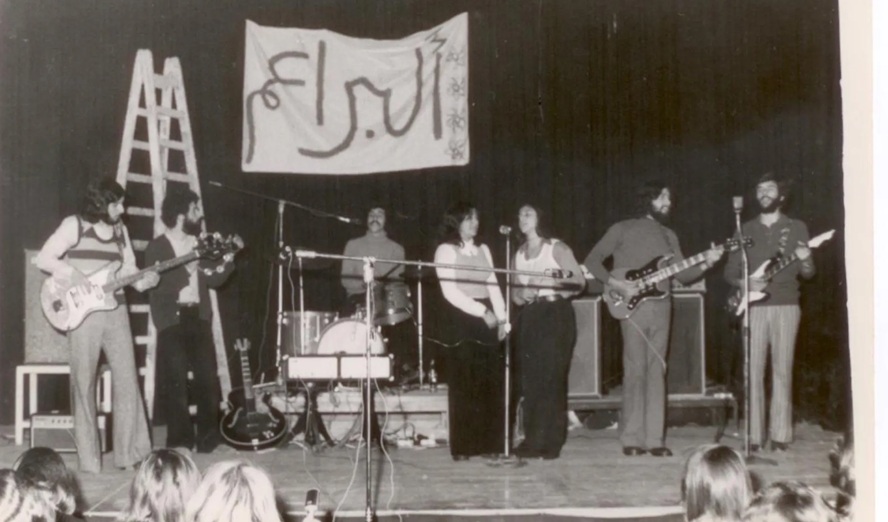
There was a time in which music, culture, and poetry merged together to make a band unlike any other: A piece of Palestinian heritage and a voice of hope for everyone, a voice that is especially relevant today. The very first Palestinian rock band, Al Bara’em was active from 1966 until 1976. In that time, band members Ibrahim Ashrawi (vocals), Alexandra Ashrawi (vocals), Samira Ashrawi (vocals), Samir Ashrawi (lead guitar), and Emile Ashrawi (drums) represented everything rock music stands for: raw emotions, freedom, and an unparalleled sense of poetic lyrics. They took big steps to enrich the music and culture of Palestine that are still visible today. Their lyrics showcase Palestine from a multitude of angles, making them a truly unique and underrated band, even within the Middle East.
Planting seeds: Cover versions and original Arabic rock
Let’s start at the beginning. The year is 1966, the prime of rock n’ roll. Artists such as The Beatles and Jimi Hendrix have reached almost every part of the world. The Ashrawi family, consisting of five siblings and a few friends, shared the stage. They played many of their covers throughout Palestine in cities such as Jerusalem, Bethlehem, Ramallah, and Qalandiya. They named themselves The Blooms, or Al Bara’em (البراعم) in Arabic. By playing covers of these musicians’ songs, they made their music accessible to the audience in Palestine. Not only that, but they also played cover songs of Arabic music legends you might also know, such as Fairuz. They were adored by the audience and content doing so in their early years.
There was a major turning point: Following the events of the Six-Day War in 1967, the band became fully actualized. They began composing their own original songs in Arabic and thus became the first Palestinian-Arabic rock band. It was more than just a band; it was a unique voice of hope and a heritage preserved in times of unprecedented change and turmoil in Palestine. Their sound was a melancholic voice that spoke to everyone – Western psychedelic rock music infused with Eastern sounds, all sung in Arabic. But it was even more than that; it was poetry. Two of their original Arabic songs were directly inspired by Palestinian poets: »Tareeq (طريق)«, meaning »Path«, by Jibreel Al Sheikh, and »Tha’er (ثائر)«, meaning »Rebel«, by Mahmoud Darwish.
Shattering walls: Progressive values and memorable shows
Al Bara’em was very progressive, as the Ashrawi sisters, Samira and Alexandra, also played on the stage, which was unheard of at the time. They admired the Lebanese singer Fairuz and made major contributions to the band by playing cover versions of Fairuz’s ballads, hereby representing an important moment in the history of not only the band but Palestine- and Bilad Al Sham-based rock music: They were women taking their space in the center of the stage, in the spotlight, as equals.
Among Al Bara’em’s many concerts, the most memorable performance was on December 27, 1973, at the Jerusalem YMCA, where the concert was sold out. They debuted their rock cover versions of Fairuz’s songs, and many described it as being for social change and freedom. They had also received a letter from the UN headquarters in Jerusalem requesting the Palestinian band to perform there. Alongside that, they played in Jordan in multiple venues such as the US Cultural Center and Cinema Rivoli, which is not widely known, as there’s no mention of them in local records, but it is a wonderful surprise nevertheless that they might have gone international had things been different.
Uncovering the roots: The quest for lost recordings
In the article »Dad rock: Rediscovering one of Palestine’s first rock bands«, published by »Arab News«, Sama’an Ashrawi is making a documentary about his father in the 1960s and 1970s. He mentions several facts that were not known to him about the band’s history – a quest of discovery, if you will. Amongst those is a crucial piece of information not only for Al Bara’em but for Palestinian history and heritage: the absence of a formal record industry due to the military occupation. This major piece of information helps understand many things as, after 1967, music was a way of expressing identity, resistance, and resilience for Palestinians. Much of it was censored, arrests were made, and even worse, some musicians were exiled. Many recordings were made outside Palestine, in Lebanon, Syria, and Egypt, where Palestinian artists lived in exile.
»There was a number of original Al Bara’em compositions that were never recorded because of the situation«, said Sama’an Ashrawi. Many existing recordings, like those found by him on a gifted family compilation, were made abroad in Egypt and Lebanon. Had it not been for Ashrawi’s efforts to bring this one-of-a-kind band to light, we might have never been able to hear them. It’s interesting to think about how many other artists recorded their unique pieces that today would be considered a piece of history if unearthed.
In 1976, four band members emigrated to the US due to the Israeli occupation of the West Bank. As so-called »Palestinian absentees«, the whole family faced multiple forms of repression. For example, Hanan Ashrawi was studying abroad in 1967 and was denied re-entry by Israeli authorities. Likely, the other siblings abroad faced the same restriction of movement while being not considered legal residents in their own homeland, thus ending almost a decade, if not more, of Al Bara’em. This was a sad end indeed. However, with the current efforts of Sam’an Ashrawi to bring this story back to life and to preserve its mark on Palestinian history and culture, there is hope and likely more music to uncover.
Link: https://albara3em.com/